
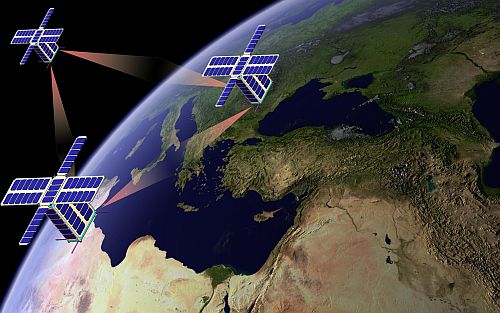
Researchers at the Technion-Israel Institute of Technology – for years experts in the miniaturization of satellites – plan to build and dispatch into space a fixed formation of three nano-satellites weighing up to six kilograms each, the first time scientists will attempt this feat.
The project, headed by Prof. Pini Gurfil of the aeronautics and space engineering faculty, is due to be unveiled officially next Monday at the Science and Technology Ministry’s International Ilan Ramon Memorial Space Conference at the Fisher Institute for Air and Space Strategic Studies in Herzliya. Representatives of space agencies and space researchers from around the world are due to attend.
“This is the first time in the world that scientists will attempt sending three satellites together in a controlled formation,” Gurfil said. “Until now, this has not been possible because of their size and weight and the problems of dispatching multiple satellites in a uniform formation and their r emaining in space for a log timne.”
The communications satellite construction will be launched in 2015. The Technion in Haifa has had much success in building satellites that are smaller than a refrigerator and thus more efficient and cheaper than devices built in the US and Europe.
The nano-satellites will try to receive signals at various frequencies from Earth and calculate the location of the transmission facility. Receiving signals in space from Earth with the help of a number of nano-satellites flying in a fixed arrangement is a new concept that has never been performed anywhere. If the experiment succeeds, said Gurfil, such satellites could be applied to locating missing persons or individuals in distress.
…
To continue reading this article, click here
Via Jerusalem Post
Photo Courtesy of the Technion
Related posts

Editors’ & Readers’ Choice: 10 Favorite NoCamels Articles

Forward Facing: What Does The Future Hold For Israeli High-Tech?

Impact Innovation: Israeli Startups That Could Shape Our Future


Facebook comments